Phd Student — Columbia University

Joshua
Ange

I am a Physics PhD student at Columbia University. My research is in cosmology, where I work on extracting robust information from some of the largest-scale observations of the universe. In particular, my past work has focused on cosmic microwave background (CMB) anisotropies, with an emphasis on CMB lensing+delensing and the thermal Sunyaev Zel'dovich (tSZ) effect.

I'm from Dallas, Texas, and graduated in 2025 with degrees in Physics and Mathematics from Southern Methodist University. I then spent a year at the University of Cambridge, where I completed an MPhil in Physics as a Churchill Scholar, before moving to New York. Outside of physics, I like ballroom dancing, hiking, reading, writing, and prehistory.
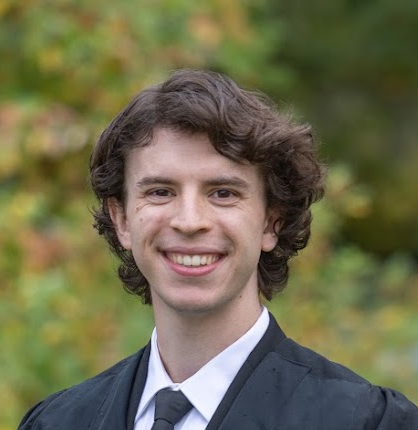
Joshua Ange

Research

Cosmology

I work on extracting cosmological information from CMB maps. This includes analytical modeling of lensing, forecasts for upcoming CMB surveys, and foreground simulations and removal pipelines. Right now, I'm working on using tSZ cluster abundances to disentangle ultra-light axion dark matter from baryonic feedback, and computing higher-order lensing information of the CMB.

CMB Foregrounds Lensing tSZ LSS Baryonic Feedback

Astrophysics & Related Work

My earlier work in high-energy astrophysics involved machine-learning methods to classify high-redshift Gamma-Ray Bursts from their prompt and pleateau emission phases, and detector characterization for the SuperCDMS SNOLAB dark matter experiment. I've also done work analyzing astrophysics literature with machine-learning and stylometric methods.

Gamma-Ray Bursts Dark Matter SNOLAB Stylometry Machine Learning

Quantum Information

Earlier work included photonic quantum computing. This involved the modeling of high-dimensional quantum photonic systems, Boson Sampling-based true random number generation, and studying how machine learning models can develop quantum architectures.

Quantum Photonics Boson Sampling Machine Learning

Publications

  1. CMB-HD Foregrounds: Simulations, Source Detection, and Foreground Removal
    A. McInnis, J. Ange, N. Sehgal, J. Kable, I. Fite
    In preparation (2026)
  2. Stylometric and Formal Patterns in the Scholarly Impact of Scientific Literature
    J. Ange, E. Godat, R. Sudan,
    SMU Journal of Undergraduate Research 9, 2 (2026) DOI
  3. Optimization and Realization of Boson Sampling for True Random Number Generation Using the Xanadu X8
    J. Ange, M. A. Thornton
    SPIE Quantum Information Science, Sensing & Computation XVII (2025) DOI
  4. Modeling and Simulation of Multiple-Valued and Nonlinear Quantum Photonic Components
    J. Ange, M. Tuller, J. M. Henderson, E. R. Henderson, B. A. Moores, D. L. MacFarlane, M. A. Thornton
    IEEE International Symposia on Multiple-Valued Logic (2025) DOI
  5. Programming Quantum Computers with Large Language Models
    E. R. Henderson, J. M. Henderson, J. Ange, M. A. Thornton
    SPIE Quantum Information Science, Sensing & Computation XVII (2025) DOI
  6. GRB Redshift Classifier to Follow Up High-Redshift GRBs Using Supervised Machine Learning
    M. G. Dainotti, S. Bhardwaj, C. Cook, J. Ange, et al.
    The Astrophysical Journal Supplement Series 277, 31 (2025) DOI arXiv:2408.08763
  7. Improving Constraints on Models Addressing the Hubble Tension with CMB Delensing
    J. Ange, J. Meyers
    Journal of Cosmology and Astroparticle Physics 10, 045 (2023) DOI arXiv:2307.01662
  8. Characterization of XIA UltraLo-1800 Response to Measuring Charged Samples
    J. Ange, R. Calkins, A. Posada
    Journal of Instrumentation 18, P01027 (2023) DOI arXiv:2209.08002

Notable Honors & Awards

Contact

Department of Physics
538 W 120th St, New York, NY 10027, USA
arxiv.org
inspirehep.net